
October 29, 2025
Dear Stravera Capital LPs,
This month’s letter focuses on Bitcoin’s near-term trajectory, liquidity and business cycles, and how market concentration and repo activity shape macro conditions for 2026.
Topics
- Four Year Cycle Fallacy
- The Two Headed Dog: Liquidity Cycles vs. Business Cycles
- Overfitting Liquidity Cycles; The Repo Market
- Market Concentration & Consumer Confidence
Four Year Cycle Fallacy
“A bet on Bitcoin’s four year cycle is a bet that broader equities markets decline in 2026.”
The four year cycle has been driven by the liquidity and business cycles, while the overall power law trend in price has been driven by adoption. The continued exponential growth in hashrate and the high correlation between traditional equities and BTC demonstrates this behavior.
Bitcoin’s hashrate has followed a power law of time raised to the twelfth power. Hashrate follows a square of price growth, which has been a remarkably stable relationship over the past 17 years. As Hashrate continues to break all-time highs and its R2 value relative to its historic trend increases, my confidence in the long term price trajectory of BTC itself only solidifies.

For the 4 year cycle to continue as it has in the past, adjusted for a power law growth trajectory, we would expect to see a peak around 200k next month, and a price that falls below 85K in October of 2026. This cyclical behavior has not been in isolation. During the last two BTC bear markets, equities have been negative over the same time period. Bitcoin’s cyclicality is married to broader economic cycles. Therefore a bet on Bitcoin’s continued four year cycle, or a bear market in 2026, is a bet that equities fall in 2026. I don’t see this trend necessarily continuing, especially with the liquidity and business cycle conditions which I will lay out in the next section.
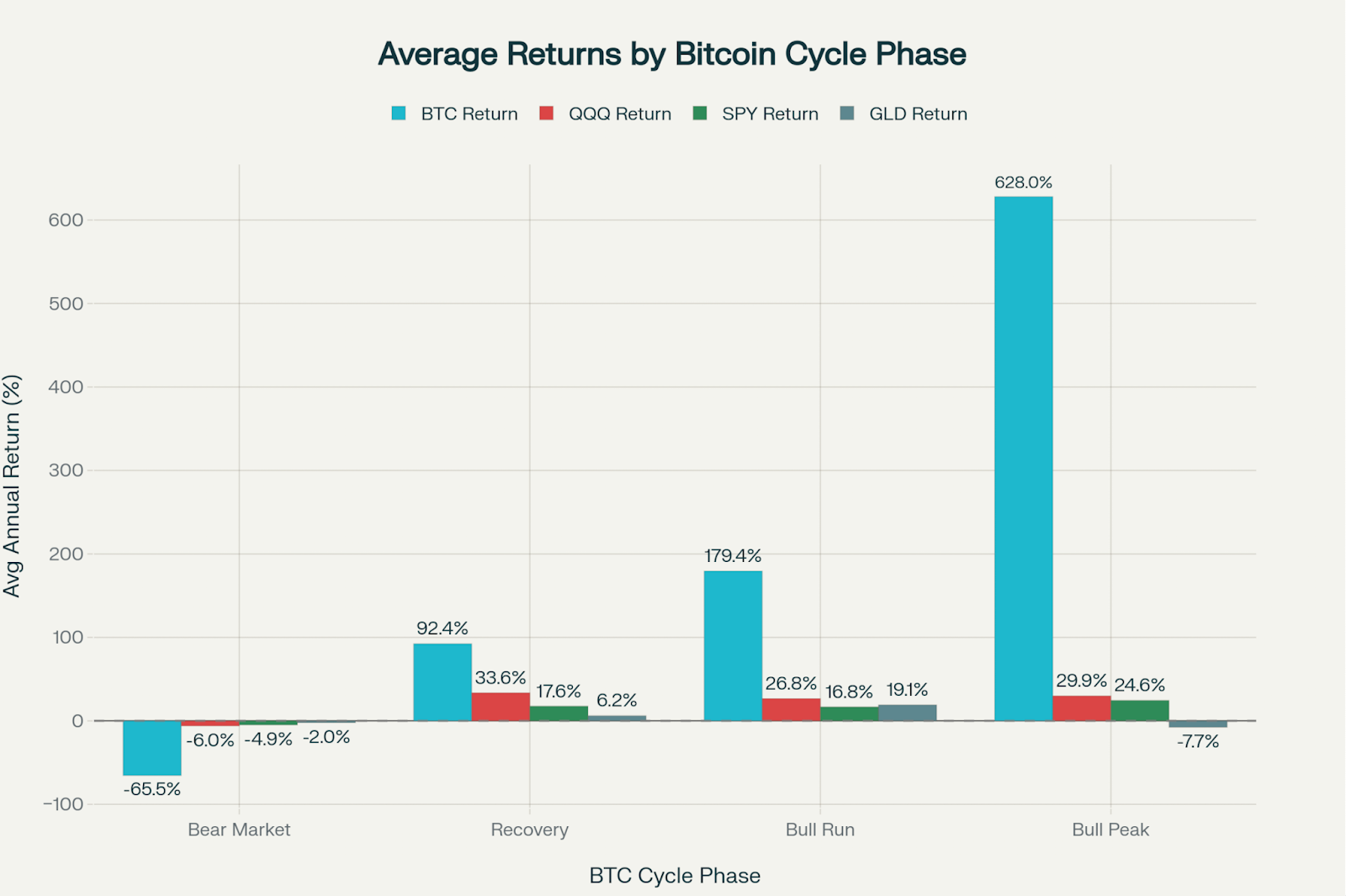

*Bitcoin’s cyclical correlation to equities
The Two Headed Dog: Liquidity Cycles vs. Business Cycles
“The liquidity and business cycles are telling two different stories.”
Liquidity Cycle:
Based on Michael Howell’s work, the global liquidity cycle, a proxy for risk taking capacity and credit creation, was expected to peak in September of 2025. As of October 27th, 2025, measures of liquidity have reached $187.5T; however, liquidity continues expanding. I appreciate the global liquidity cycle analysis, but find problems in the overfitting of a sine wave to such financial market conditions. The current factors pushing liquidity higher:
- China’s aggressive monetary stimulus (approximately $1.5T of injections over 6 months). October alone saw the PBOC inject 900B Yuan via their medium term lending facility.
- US Treasury account drawdown injecting $500B into money market funds.
- Weakening dollar through 2025.
- Decreased bond market volatility (MOVE index), which allows for stronger collateral.
Using Howell’s words, we are in the speculation phase of the 65-month credit cycle. Especially amidst the current rate-cutting cycle and the fact that the Fed has broadcasted the end of QT, there remains a runway for expanding financial conditions.
Business Cycle:
The business cycle is likely the greatest explanatory factor as to why Bitcoin hasn’t had a blowoff top during this cycle. Although it feels as though BTC is underperforming, the only real underperformance is relative to AI stocks.
The fact that Bitcoin remains along the power law trendline while the PMIs are subdued is likely a result of the front running of interest rates and loose liquidity conditions over the past two years. In my view, the power law trend remains a very fair valuation for BTC’s current price based on the broader markets.
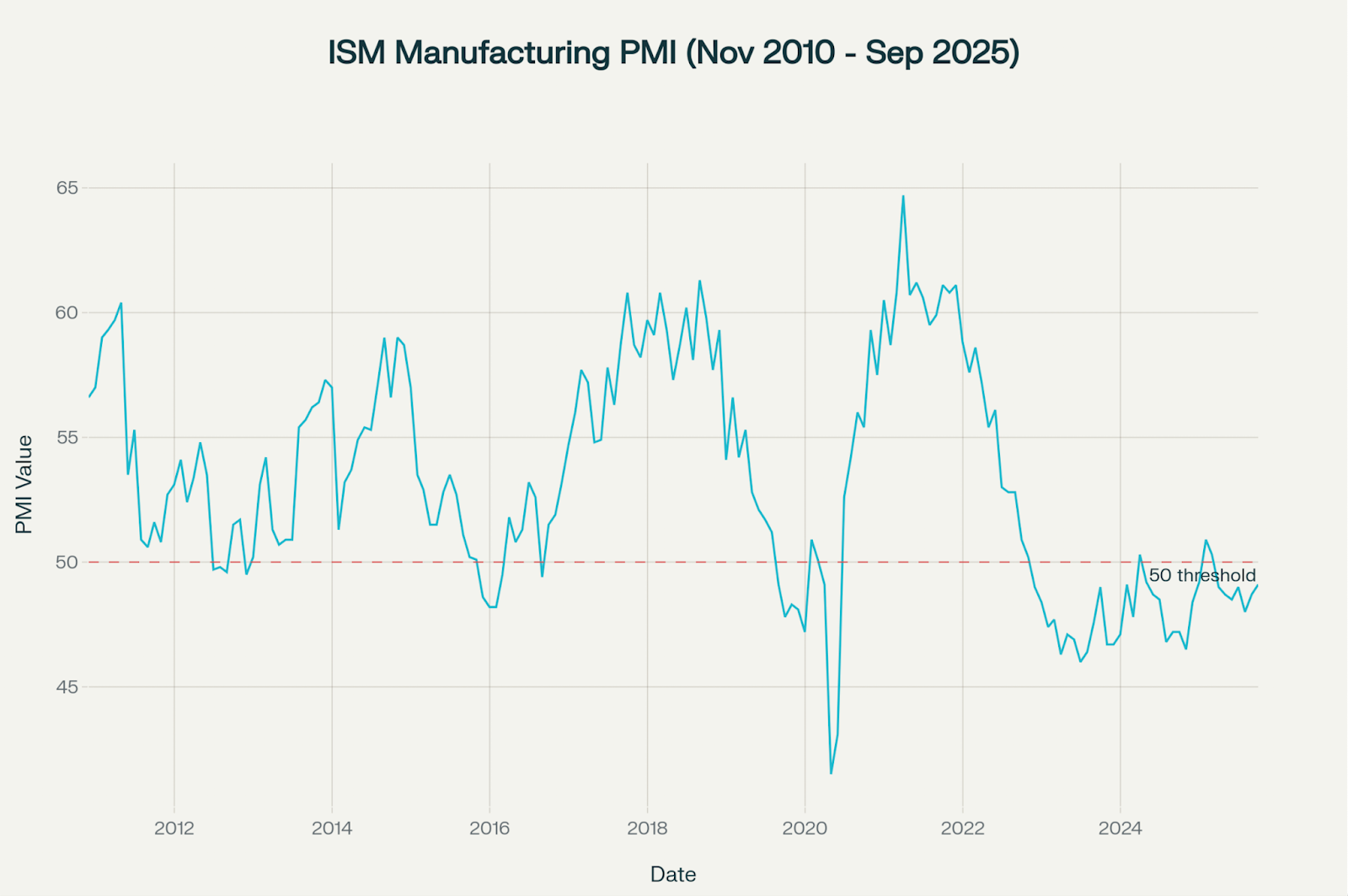
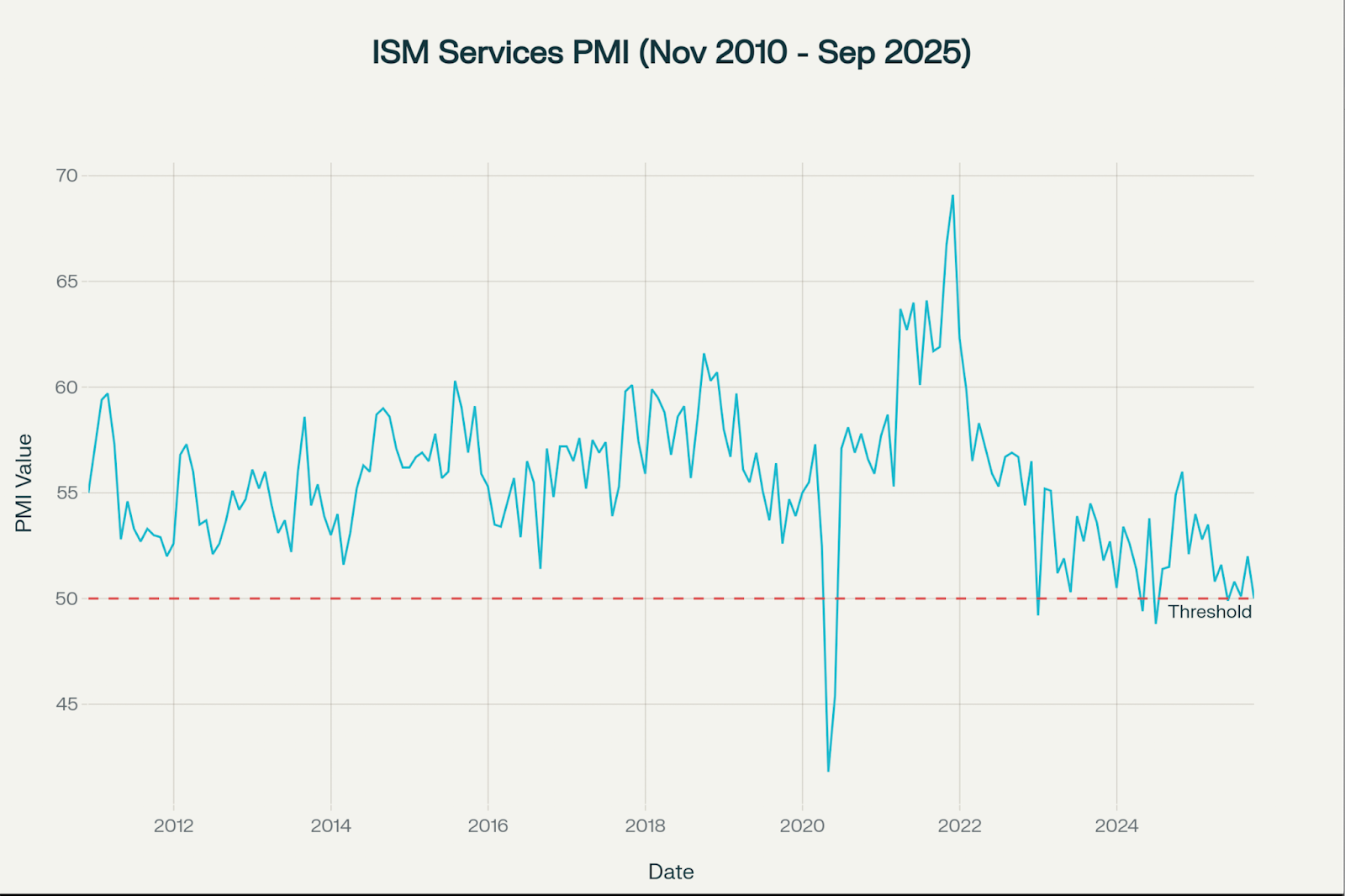
All of this is to say that until economic conditions begin to expand, there is unlikely to be an aggressive bid on BTC. Coupled with the distribution of long term holders across the BTC market over the last month, as we sit right along the power law trend line, the safest expectation is that we will continue along this modest upward trajectory.
Overfitting Liquidity Cycles; The Repo Market
“Liquidity has dried temporarily, but still positive liquidity events remain on the horizon.”
The repo market has been raising concerns for systemic liquidity in the US, but I am not overly concerned with this threat. The Federal Reserve’s Standing Repo Facility has been tapped twice in October for $7.7B and $8.5B on consecutive days. Banks are borrowing cash overnight from the Fed using government debt as collateral, meaning there is clearly a need for liquidity in the system. Furthermore, bank reserves are roughly $300B below what cross-border capital deems “safe levels” of liquidity. These two factors likely explain the lack of explosive behavior in BTC coupled with the extreme distributions of coins by long term holders through the month of October.
The biggest risk I see is the fact that Cross Border Capital’s Fed liquidity injections project a significant decline in liquidity over the next six months much like the beginning of 2022. I don’t, however, see this as the end-all-be-all scenario. Powell’s most recent remarks on the end of QT and the outlook for balance sheet expansion seem to be contrary to the assumption of a typical global liquidity cycle. Therefore, I remain neutral and have a slightly positive liquidity bias for 2026.
Market Concentration & Consumer Confidence
“Bitcoin is not underperforming the broader market, but is instead underperforming the Mag 7.”
I will wrap up with the concentration of the broader equities market. It is easy to conclude that Bitcoin is underperforming the equity market during 2025.
The PMIs provide the first part of the picture, which shows the troublesome economic conditions for companies that are not directly benefiting from AI capex spend. The chart on the left below shows the 5-year performance of the Mag 7 relative to the rest of the equities in the S&P index over the last five years. On the right, you can see the growth in AI-related earnings in the S&P. It’s clear that AI spend completely dominates equity performance.
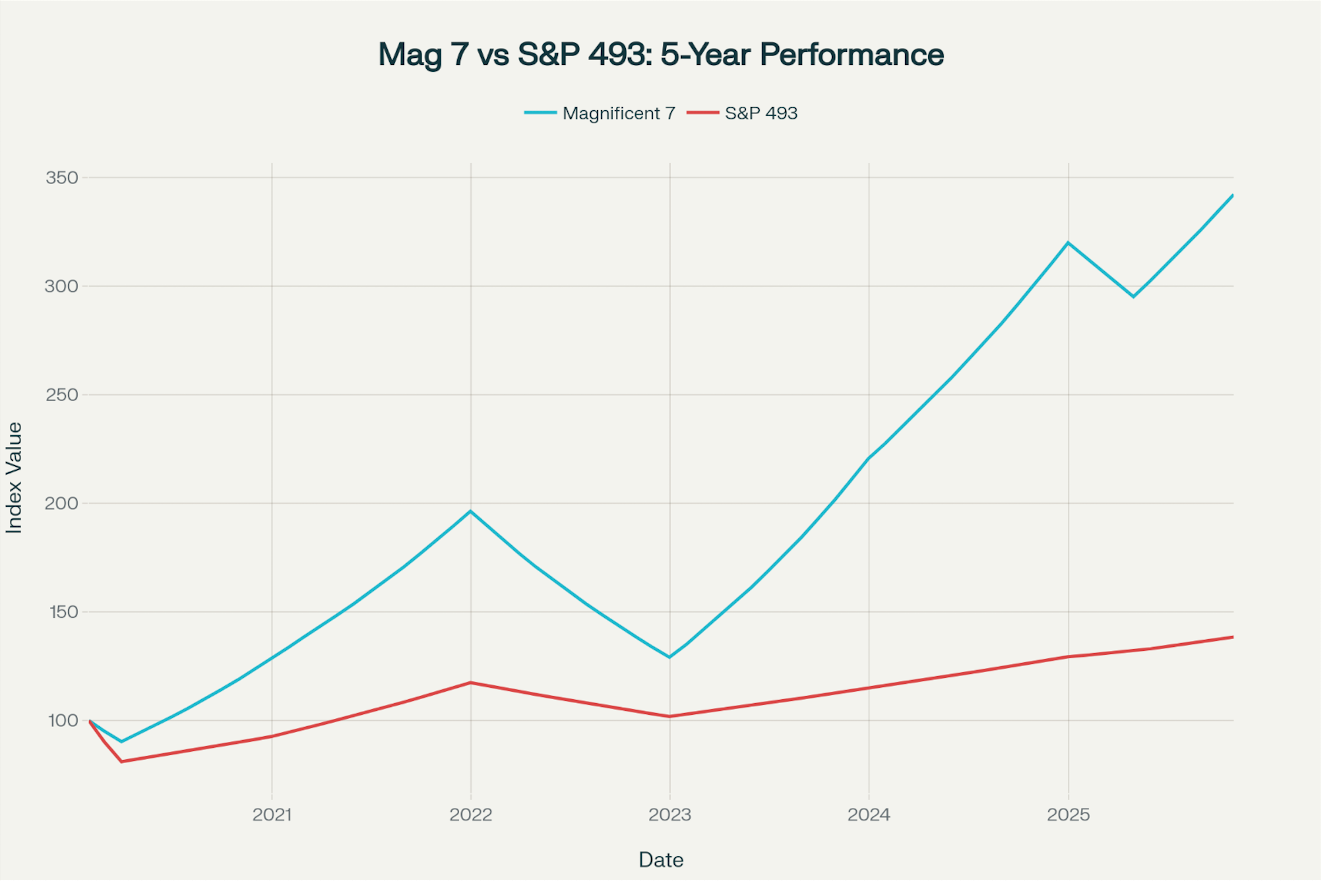
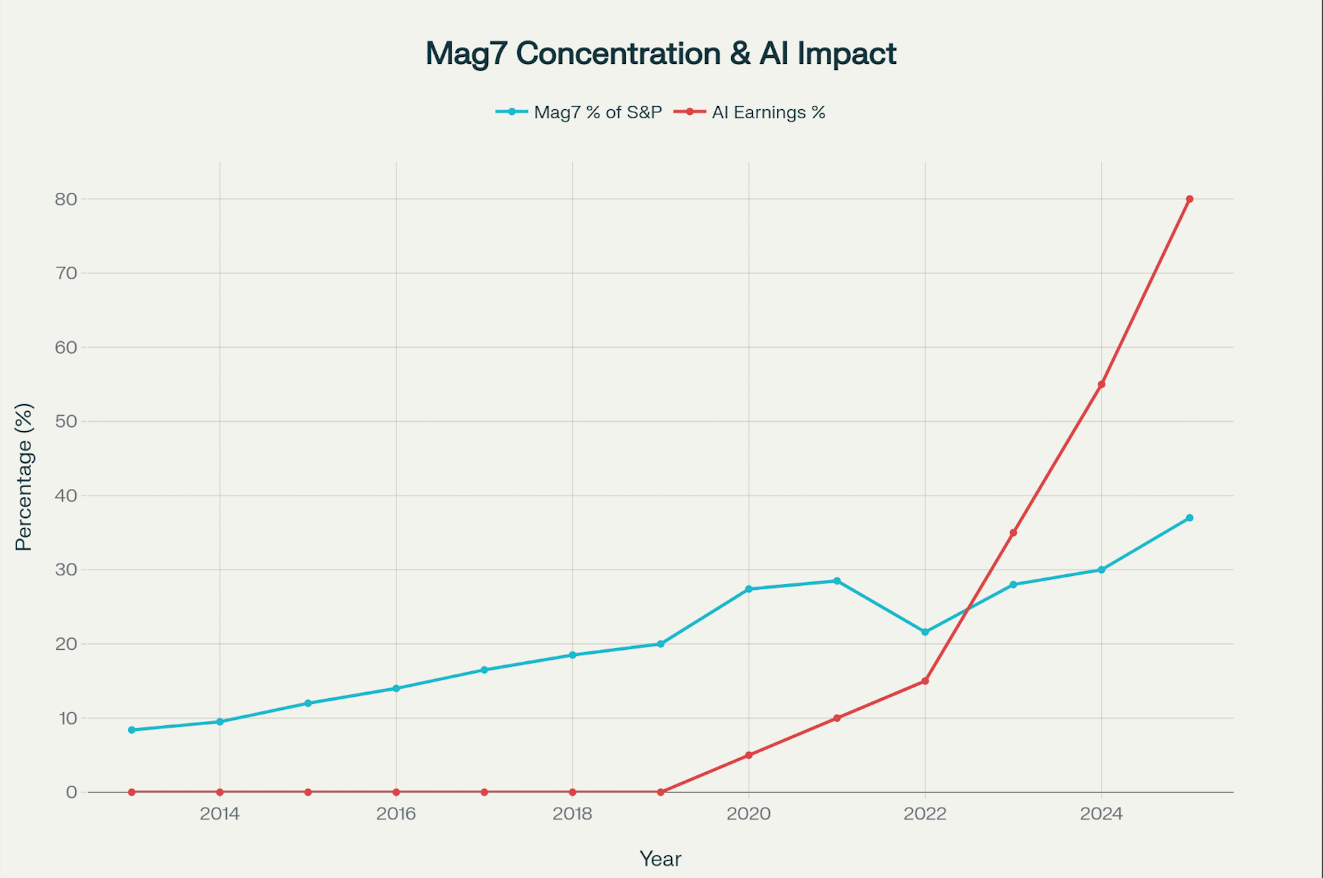
The earnings growth and lagging price performance of the majority of companies in the index illustrates the broader picture that not all assets are performing. The bubble phases in BTC tend to occur during periods of economic expansion across the broader market as evidenced by the PMIs. The underperformance of the equal weight index relative to AI stocks paints the same picture of lagging economic conditions in the market. I don’t expect there to be any form of exponential bubble in the near term so long as broader economic conditions continue to remain poor. The slow march higher along the BTC power law trend is my expectation for 2026. The real indicator will be how aggressively the Fed pivots to QE in 2026 and how aggressive this rate-cutting cycle will be. My outlook remains conservatively bullish for 2026.
Sincerely,
Dan Hillery
Chief Investment Officer
Stravera Capital